


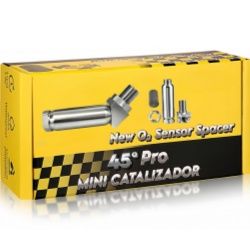
NEW 45° O2 Sensor Spacer Mini Catalizador Mini Catalytic Converter to Fix CEL P0420 P0430
NEW 45° O2 Sensor Spacer Mini Catalizador Mini Catalytic Converter to Fix CEL P0420 P0430
🔒Genuine Product-Laser Security Mark
✔️Universal for All Vehicles
💯Full Refund If No Effect
Most orders ship from nearby U.S. warehouses
Order within
--:--:--Cutoff: 3 PM PT
FREE Shipping
3–5 days
Typical Standard delivery
Faster Shipping
Expedited: ~2 days
Express: ~1 day
🔥 Final Days – While Supplies Last!
Couldn't load pickup availability
 Proudly Made in USA
- Paypal payment method
- Shopify pay payment method
- Visa payment method
- Master payment method
- American express payment method
- Apple pay payment method
- Google pay payment method
Frequently bought together

O2 Sensor Socket

O2 Sensor Socket Set

-
Ordered
- - -
Order Ready
- - -
Delivered
Fits my car?
Check for an M18 × 1.5 mm O2 sensor thread and enough installation space.
Which model?
Roomy: Straight. Tight: 45° / 90°. Ask your mechanic if unsure.
How many?
Quantity depends on your downstream O2 sensor setup. Confirm with your mechanic.
Made & shipped
Made in the USA. Shipped from California, USA.
Universal NEW O2 Sensor Spacer with Mini Catalytic Converter – The Ultimate Solution for P0420/P0430 Codes !
Say goodbye to pesky check engine lights and hello to smoother rides with our Universal NEW O2 Sensor Spacer with Mini Catalytic Converter. Designed to tackle O2 sensor issues, this high-performance Oxygen Sensor Extender is your go-to fix for those troublesome P0420 and P0430 codes.
Key Features:
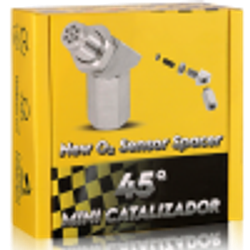
- 45-Degree Design: The innovative 45-degree angle design provides extra room for optimal O2 sensor readings and effective air degreasing. This ensures your exhaust system functions at its best, improving overall vehicle performance.
- Built-In Micro Catalytic Converter: This spacer includes a mini catalytic converter that effectively eliminates check engine light (CEL) triggers caused by modifying your exhaust system or removing the catalytic converter.
- Universal Fit: Compatible with most vehicles that feature M18X1.5 threads, this O2 sensor spacer is versatile and easy to install. It fits seamlessly into narrow installation spaces, making it perfect for a range of applications.
- Durable Construction: Made from high-quality stainless steel, this oxygen sensor extender is built to last. It offers robust performance and reliable strength, ensuring long-term use without compromising on quality.
Easy Installation: No modifications needed! Simply jack up your car if necessary, replace the old O2 sensor spacer with the new 45-degree extender, and secure it with a wrench. It’s that simple!
Specifications:
- Sensor Type: Magnetic Induction
- Hysteresis: 45 degrees
- Material: Stainless Steel
- Color: Silver
- Applications: For vehicles with M18X1.5 threads
Common Issues Addressed:
Check Engine Light (CEL): A common indicator of faulty catalytic converters, often triggering codes like P0420 or P0430.
Lack of Power: Noticeable power drop after your vehicle warms up.
Speed Limitation: Difficulty exceeding speeds of 30-40 mph.
Unpleasant Odors: Rotten egg smell from the exhaust.
How to Install:
Preparation: Jack up the vehicle if needed and locate the O2 sensor bung that requires replacement.
Replacement: Loosen the old spacer, install the new 45-degree sensor spacer by hand, then tighten with a wrench.
Adjustment: Ensure proper fit and function for optimal performance.
Package Includes:
1 x Universal NEW 45° O2 Sensor Spacer with Mini Catalytic Converter
Upgrade your vehicle's exhaust system with the NEW O2 Sensor Spacer with Mini Catalytic Converter and experience improved performance and reliability. Say goodbye to check engine lights and enjoy a smoother, more efficient ride!
Applicable error codes: P0420, P0421, P0422, P0423, P0424, P0430, P0431, P0432, P0433, P0434. Notes:
- Install on the rear O2 sensor only. Installing on the front O2 sensor will not work.
- Before use, make sure the O2 sensor is functioning properly. This product is suitable for solving CEL issues caused by aged catalytic converters, catalyst mismatch, or low conversion efficiency after exhaust modifications.
- Do not overtighten during installation. If you feel strong resistance while tightening, stop immediately.
Product Disclaimer: Our O2 Sensor Spacer is designed to eliminate the check engine light (CEL) caused by catalyst codes. While it may help your vehicle pass emissions inspections smoothly, we do not encourage using it for that purpose.
-

For a minimum amount of money and time, I have my race car to pass inspection and it is street legal. Thanks to the o2 spacer , I got it almost overnight another plus to this company!
-

Had p0420 code for about a year and tried other o2 sensor spacers and they failed! Put this one in and it's been going on 2 months and no more p0420 code!
-

Took me over a year and several new O2 sensors along with two new cats and only these pieces kept my check engine light off and allowed my truck to pass the emissions test.


How to Use?
How to Use?
Please visit our installation page to watch the tutorial: https://www.minicatalytic.com/pages/how-to-use.
Follow the instructions carefully for a 100% guaranteed fix of the CEL warning light.
Delivery Information
Delivery Information
We ship all orders from California, USA. Orders placed before 3:00 PM PT ship the same business day. Orders placed after the cutoff time will ship the next business day.
Shipping Options
Standard (Free)
Shipped via USPS Ground Advantage.
Estimated delivery time: 3–7 business days (shipping time only, processing time not included).
Expedited (+$60.00)
Shipped via Amazon Shipping, USPS Priority Mail Express, or UPS 2nd Day Air®, depending on your location and availability.
Estimated delivery time: 1–2 business days (shipping time only, processing time not included).
Please Note:
- UPS 2nd Day Air® delivers on business days only (no weekend delivery), and weekends are not counted in transit time.
- Amazon Shipping and USPS Priority Mail Express support weekend delivery in most areas.
- All delivery estimates are calculated from the day the carrier scans the package.
- Delays may occur during severe weather or peak holiday seasons.
In most cases, up to 73% of expedited orders are delivered within 1 business day. This is possible because we operate multiple warehouse locations across the United States, giving us a strong nationwide supply chain advantage.
We always strive to ship your order as quickly as possible. Thank you for your understanding and support!


HOW TO CHOOSE THE RIGHT MINI CATALIZADOR®
Choosing the right Mini Catalizador® is simple. Just follow these 3 steps:
CHECK YOUR O2 SENSOR THREAD
Mini Catalizador® O2 sensor spacers use a universal M18 × 1.5 thread and are designed for most vehicles with a threaded downstream (post-cat) O2 sensor.
The spacer must be installed on the downstream/post-cat O2 sensor, not the upstream/pre-cat O2 sensor.
CHOOSE THE RIGHT ANGLE
Choose the angle based on the available space around your downstream O2 sensor:
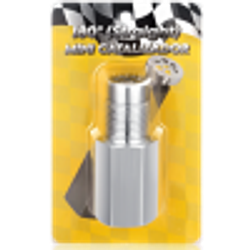
- Straight (180°)
- Best when there is plenty of space around the O2 sensor.
- 45°
- A good choice when moderate clearance is needed.
- 45° Pro
- Same 45° angle, but with a larger internal catalytic core for stronger performance.
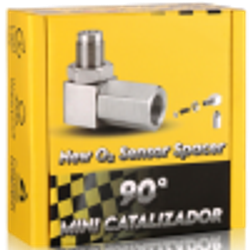
- 90°
- Ideal for tight spaces and our most popular option.
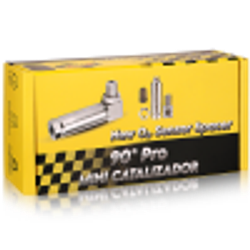
- 90° Pro
- Same 90° angle, but with a larger internal catalytic core for stronger performance.
Not sure which angle to choose? The 90° version is usually the easiest choice when space is limited.
CHOOSE THE CORRECT QUANTITY
The number of Mini Catalizador® spacers you need depends on the number of downstream/post-cat O2 sensors on your vehicle.
Install 1 spacer for each downstream/post-cat O2 sensor.
COMMON EXAMPLES:
- Many 4-cylinder vehicles typically have 1 downstream O2 sensor → 1 spacer.
- Many V6/V8 vehicles have 2 downstream O2 sensors, usually one for each bank → 2 spacers.
WHAT ABOUT P0420 OR P0430?
P0420 and P0430 are catalytic-efficiency-related trouble codes. They can help identify which bank is reporting the issue, but the code alone does not determine how many spacers you need.
The safest way to choose the quantity is to count the downstream/post-cat O2 sensors on your vehicle.
- P0420 → Bank 1 Catalytic Efficiency Below Threshold
- P0430 → Bank 2 Catalytic Efficiency Below Threshold
If your vehicle has both P0420 and P0430 and has 2 downstream O2 sensors, you will typically need 2 spacers — one for each downstream O2 sensor.
QUICK GUIDE
- Thread:
- M18 × 1.5
- Installation Position:
- Downstream / Post-Cat O2 Sensor
- Quantity:
- 1 spacer per downstream O2 sensor
- Angle:
- Choose based on available clearance
Not sure which angle? → 90° is the most popular choice for tight spaces.
Mechanic Approved

Built-in Mini Catalytic Converter
This oxygen sensor spacer features a stainless steel housing and a real 400CEL mini catalytic converter with precious metals (Pd, Pt, Rh) and EU5 coating. With an M18x1.5 thread, it fits most oxygen sensors, helping stabilise readings, minimise error codes, and improve exhaust emissions.

Perforated Top Cover
Stainless steel (polished)
Mini Catalytic Converter
Made of metal with noble metals layer

Precious Metals Coating (Pd, Pt, Rh)
The mini catalytic converter is coated with Palladium (Pd), Platinum (Pt), and Rhodium (Rh).
These noble metals act as active catalysts, efficiently converting harmful exhaust gases into less harmful emissions while ensuring long-lasting performance.
External Thread Size: M18x1.5
Standardised thread for the oxygen sensors
OXYGEN SENSOR SPACER
Compliant with the lambda probe standard (internal thread size: M18)
A Stainless Steel Housing
High temperature and corrosion resistant
Where to install?
Please Click the + button to view. note: Be sure to tighten the top cap and then install it on the second oxygen sensor (located after the catalytic converter).

Primary Oxygen Sensor
Located between the engine and the catalytic converter, the primary oxygen sensor sends signals to the vehicle's ECU so it can adjust the air-fuel ratio. The Oxygen Sensor Spacer should NOT be installed on this sensor.
Catalytic Converter
The catalytic converter removes pollutants and emissions produced by the vehicle's engine.
Oxygen Sensor Spacer
Removes the oxygen sensor from the direct path of exhaust gases. This allows the oxygen sensor to read properly when installing a high-flow catalytic converter or off-road pipe.
Secondary Oxygen Sensor
Located after the catalytic converter, this sensor is used to monitor the performance and efficiency of the catalytic converter. If you install a high-flow catalytic converter or off-road test pipe, an Oxygen Sensor Spacer must be installed on this sensor to avoid a Check Engine Light. The Oxygen Sensor Spacer should be installed on this sensor.
Installed Here
We offer three different angles of O2 sensor spacers to accommodate various tight spaces.
Mechanics Are Using...⭐️⭐️⭐️⭐️⭐️
Questions? We Have Answers
What is the new O2 sensor spacer?
What is the new O2 sensor spacer?
A new O2 sensor spacer differs from the older version in that it integrates a mini catalytic converter within the spacer. This new design works similarly to larger catalytic converters, where harmful exhaust gases pass through a ceramic honeycomb element coated with platinum, rhodium, and palladium. These materials help oxidize and convert harmful pollutants in the exhaust gases. Inside the honeycomb, a chemical reaction takes place, transforming the pollutants into harmless carbon dioxide (CO2) and water (H2O), while also converting nitrogen oxides (NOx) back into nitrogen (N2) and oxygen (O2).
Our new O2 sensor spacer not only converts harmful emissions but also sends the expected exhaust readings to the ECU, ensuring that the ECU operates optimally to produce additional horsepower. This helps to eliminate the Check Engine Light (CEL) caused by incorrect O2 sensor readings, improving both engine performance and emissions efficiency.
Will this new O2 sensor spacer fix my CEL?
Will this new O2 sensor spacer fix my CEL?
The new O2 sensor spacer with a built-in mini catalytic converter is specifically designed to address CEL issues caused by high-flow catalytic converters (HIFLOW Cat) or deleted catalytic converters in the exhaust system. By adjusting the position of the O2 sensor, it makes the ECU believe there is a properly functioning catalytic converter in the exhaust system, which typically helps eliminate P0420 and P0430 error codes.
The built-in mini catalytic converter works similarly to a traditional catalytic converter, converting harmful exhaust gases into harmless substances, effectively "tricking" the ECU into thinking the catalytic converter is still working. This is especially suitable for vehicles with modified or removed original catalytic converters.
Although this product is effective in most cases at resolving CEL issues caused by O2 sensors, results may vary depending on exhaust system layout, ECU tuning, and specific vehicle modifications. Therefore, it cannot be guaranteed to resolve the issue for all vehicles.
How does the new O2 sensor spacer work?
How does the new O2 sensor spacer work?
The new O2 sensor spacer is equipped with a mini catalytic converter that features a ceramic honeycomb structure coated with platinum, rhodium, and palladium. This mini converter effectively oxidizes and transforms harmful emissions.
Through catalytic reactions, it converts carbon monoxide (CO), nitrogen oxides (NOx), and hydrocarbons (HC) found in vehicle emissions into harmless carbon dioxide (CO2) and water (H2O). The precious metals—platinum, rhodium, and palladium—act as catalysts in this process, reducing the emission of harmful gases. By simulating the function of a full-sized catalytic converter, the O2 sensor spacer ensures that the O2 sensor receives the expected exhaust data, which in most cases clears the check engine light (CEL).
Is the new O2 sensor spacer compatible with my vehicle?
Is the new O2 sensor spacer compatible with my vehicle?
The new O2 sensor spacer is designed for O2 sensors with M18 x 1.5mm threads, which covers 99% of O2 sensor threads. It is compatible with a wide range of vehicles, including BMW, Audi, Toyota, Nissan, Volkswagen, Subaru, Honda, and more, fitting engines from 1.6L to 6.3L, both turbocharged and non-turbocharged.
What material is the new O2 sensor spacer made of?
What material is the new O2 sensor spacer made of?
The product is made of high-quality T-304 stainless steel, ensuring it is rust-resistant, corrosion-resistant, peel-free, and flake-free. It has excellent high-temperature durability, capable of withstanding working temperatures up to 620°F (approximately 327°C), making it suitable for long-term, high-temperature environments. Unlike alternatives made from zinc-plated carbon steel or filled with steel wool, our O2 sensor spacer is entirely constructed from T-304 stainless steel, which will not experience coating peeling or rusting at high temperatures. This ensures long-lasting, reliable performance, making it the ideal solution for O2 sensor issues.
How to install the new O2 sensor spacer?
How to install the new O2 sensor spacer?
Installation is very simple and quick, typically taking no more than 10 minutes. Just screw the new O2 sensor spacer onto the existing O2 sensor, then reinstall it into the O2 bung. No welding, soldering, or wiring is required, and it can be easily removed at any time if necessary.
Does my vehicle need one or two new O2 sensor spacers?
Does my vehicle need one or two new O2 sensor spacers?
For vehicles with a dual exhaust system or V6/V8 engines, two new O2 sensor spacers are typically required (one for each exhaust pipe). Each exhaust pipe has a post-cat O2 sensor (located after the catalytic converter), so one spacer is needed for each O2 sensor to ensure the exhaust system operates correctly and to prevent triggering the check engine light (CEL). If your vehicle has a single exhaust system, only one spacer is needed.
What model of the new O2 sensor spacer do I need?
What model of the new O2 sensor spacer do I need?
The new O2 sensor spacer is available in three angle options: 0° (straight), 45°, and 90°, and is compatible with all vehicles equipped with M18 x 1.5mm O2 sensor bungs. The choice of the appropriate model typically depends on the space available at the O2 sensor location. If the exhaust system has tight or hard-to-reach spaces, a 45° or 90° spacer may be more suitable. Please select the angle based on your vehicle’s exhaust system layout for the best fit during installation.


